
When Nigeria gained independence in 1960, the air was filled with hope, songs of freedom, and dreams of a new nation standing tall among the world’s greats. The green and white flag did not just symbolize liberty; it carried the promise of a fertile land whose soil had sustained generations.1
KEY TAKEAWAYS:
- Agriculture built Nigeria: 70%+ of GNP at independence (1960), sustained the young nation2
- Regional diversity: From groundnut pyramids in Kano to cocoa in the West, palm oil in the East
- Agriculture still employs 30.1% of Nigeria’s workforce—more than any other sector3
- The foundation: Agriculture was the economic engine that powered Nigeria’s first decade
Reading time: 6 minutes | Part 1 of 3 | Recommended for: Policymakers, agricultural investors, development partners
The First Engine of Growth: Agriculture’s Golden Era
At the heart of our country’s economy then was Agriculture, the pride of the new nation. From the vast groundnut pyramids of Kano to the cocoa farms of the West, from palm oil in the East to cotton and sorghum in the North, agriculture was more than just farming; it was the lifeblood of the economy. At independence in 1960, agriculture contributed over 70% of Nigeria’s Gross National Product and provided the largest share of foreign exchange earnings.2
For a young Nigeria, agriculture was both the engine of growth and the thread weaving together the country’s diverse regions.
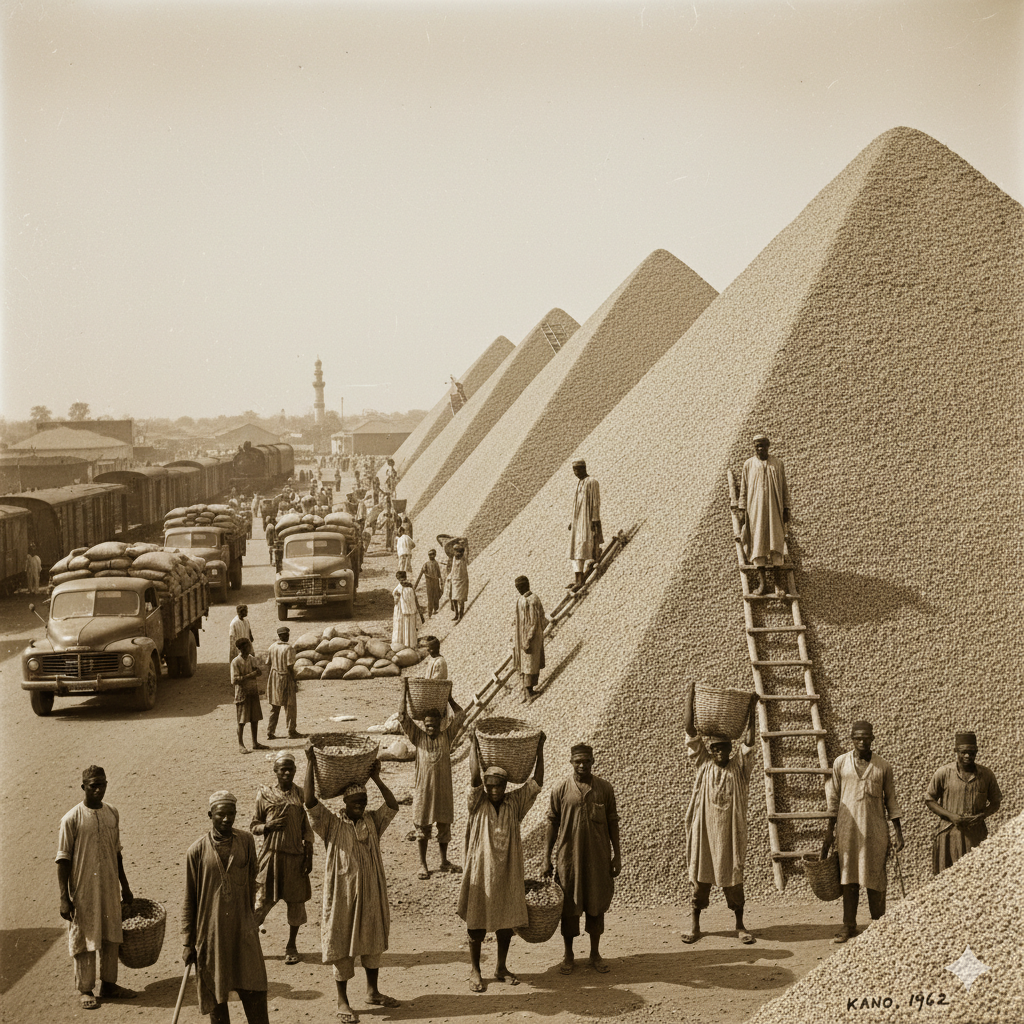 Historical image of Groundnut Pyramids in Kano, Nigeria, circa 1962. Generated using Google Gemini AI.
A Shift in Focus, An Enduring Foundation
Over time, the economy shifted focus; oil was discovered, and the bright flame of agriculture dimmed in national discourse. Yet, agriculture never left the stage. It remained a quiet but resilient backbone, feeding millions, employing people, and providing opportunities where industries and oil wells could not reach. Even today, agriculture remains Nigeria’s largest employer, with 30.1% of the employed population working in agriculture, forestry, and fishing, while supporting countless more through processing, trade, and distribution.3
A Unifying Force Across Diverse Regions
One remarkable success is how agriculture has spread across all regions of the country, harnessing her diverse climates. The North thrives with cereals, groundnuts, tomatoes, and livestock. The West dominates in cocoa, cassava, and poultry. The East flourishes with palm oil, fruits, and fisheries. The Middle Belt grows yams, rice, and grains in abundance.4 This regional spread has ensured that no part of our country is left out of the nation’s food and labour force supply.
Agricultural Typologies Across Nigeria
The map below illustrates the agricultural landscape across Nigeria’s 784 Local Government Areas, based on the FAO Hand-in-Hand Initiative’s Agricultural Typology analysis.5 This innovative framework identifies micro-regional innovation opportunities, bottlenecks, and investment gaps by analyzing three key components:
Agricultural Potential measures the maximum income smallholder farmers can achieve under optimal conditions, considering both biophysical and economic factors. Agricultural Efficiency indicates how much of this potential is currently realized, revealing opportunities to reduce transaction costs and improve market access. Priority highlights regions with the greatest need for development investment, measured by local population wellbeing.6
The resulting seven typology classes combine these dimensions to guide targeted agricultural interventions across the country. Zoom in to explore individual LGA classifications and performance metrics.
Data Source: FAO Hand-in-Hand Initiative – Agricultural Typologies (2024)
Methodology: Stochastic Frontier Analysis combining household surveys and geospatial data
Citation: FAO Hand in Hand Initiative - Stochastic Frontier Analysis Task Force
License: CC BY-NC-SA 3.0 IGO
More Information: FAO Data Catalog
Beyond Food: Fueling Human Development
Beyond food and exports, agriculture has contributed immensely to human development. By providing jobs for millions of rural households, it has reduced poverty levels, created smallholder businesses, and offered opportunities to women and youth.7 Initiatives in irrigation, mechanization, and agribusiness have created new employment pathways. In recent decades, agriculture has not only kept our country nourished, but also pushed her upward on the Human Development Index (HDI), by improving access to income, education, and health.8
References
Continue Reading: Part 2: The Paradox—Why Farmers Remain Poor
In Part 2, we examine the troubling contradiction: agriculture employs more Nigerians than any other sector, yet farmers remain among the poorest citizens. Discover the infrastructure gaps, post-harvest losses, and planning failures keeping agriculture from reaching its potential.
Want to unlock Nigeria’s agricultural potential? Contact us
Footnotes
-
Central Bank of Nigeria (2020). “Agricultural Financing in Nigeria: 60 Years Since Independence.” CBN Economic and Financial Review, Vol. 58, No. 3.
Chronicles agriculture’s role as the economic foundation of independent Nigeria. ↩ -
Voice of Nigeria (2024). “Driving Nigeria’s Agricultural Productivity Through Policies, Programmes and Projects Since 1960.” VON News.
Vanguard (2011). “Appraising Nigeria’s Agriculture Since Independence.” Vanguard Nigeria. ↩ ↩2 -
National Bureau of Statistics (2023). Nigeria Labour Force Survey Annual Report 2023. NBS Publication.
NBS (2024). Nigeria Labour Force Survey Q1 2024 Report. NBS Publication. ↩ ↩2 -
Federal Ministry of Agriculture and Rural Development (2023). “Agricultural Production Survey by Geopolitical Zones.” FMARD Nigeria.
Premium Times (2022). “Nigeria’s Agricultural Diversity: Regional Comparative Advantages.” Premium Times Analysis. ↩ -
FAO Hand-in-Hand Initiative (2024). Agricultural Typologies for Nigeria. Food and Agriculture Organization. FAO Data Catalog. License: CC BY-NC-SA 3.0 IGO. ↩
-
FAO Hand-in-Hand Initiative (2024). “Stochastic Frontier Analysis Methodology for Agricultural Typologies.” FAO Task Force Technical Documentation.
This methodology combines household survey data with geospatial analysis to identify agricultural potential, efficiency, and development priorities. ↩ -
African Development Bank (2023). “Agricultural Transformation for Inclusive Growth and Jobs Creation in Nigeria.” AfDB Country Focus Report.
World Bank (2022). “Nigeria Agriculture Sector Review: Unlocking Agricultural Potential.” World Bank Group. ↩ -
UNDP (2023). Human Development Report 2023: Nigeria. United Nations Development Programme. UNDP HDR.
Nigeria’s HDI has improved from 0.434 (2000) to 0.535 (2022), with agriculture playing a key role in rural income growth. ↩